1:1 Coaching for Men Over 40 Who Refuse to Slow Down
A plan you will still be running in a year does not get written in a conversation. It gets built by running it. Six weeks: we assess where you actually are, we build the plan around your real life, you run it while I adjust it week by week — and then we measure again.
Not a trial. Not a discovery call. The work.
This is Stage 2 of the Long Game Method
Almost every man who comes to me has already tried. Usually more than once. He bought the program, he showed up, and for a few weeks it worked — and then a travel month happened, or a shoulder went, or work got loud, and the plan did not bend. So he stopped.
The reason it did not hold was never effort. It was that nobody was adjusting the plan when his life changed. That is the part you cannot do for yourself, and it is the whole reason this works.
The Long Game Blueprint is your personal training, nutrition and recovery system — built from scratch around where you actually are, what your week actually looks like, and what your body will actually tolerate. Six weeks is how long it takes to build one properly and prove it holds.
Six weeks is not a package length. It is how long it takes to build a plan that is actually yours.
Anything written on day one is a starting guess — an informed one, but a guess, built from what you have told me about your life. The customising happens in the running. Week two shows me what your shoulder does under load. Week three shows me what a bad work week does to your sleep. Week four shows me what you actually eat, rather than what you meant to.
Every one of those is a change to the plan. Six weeks is enough of them that by the end it is not a plan for a man like you. It is yours.
A 60-minute onboarding deep-dive: your training history, your schedule, your injuries, what has worked before and what has not. Then your performance and body composition baseline, and your Blueprint written around all of it.
You run the plan. Every week you report in, I read every check-in myself, and the plan changes to match what your body and your week actually did. This is where a plan becomes yours rather than mine.
The same measurements we took in week one. Not a feeling — numbers. You see exactly what moved, and you leave holding a plan that has already been stress-tested against six weeks of your real life.
60 minutes, 1:1. Your training history, your schedule, your constraints, your injuries. We build on what you have already done, not against it.
Performance markers and body composition, measured properly at the start so week six means something.
A custom plan across all four pillars of the Long Game Framework: Train, Fuel, Recover, Measure. Training structure, nutrition strategy, recovery framework, and an obstacle map for the weeks that go sideways.
Delivered daily through Everfit, with video for every movement. You open your phone and you know exactly what today is.
You report, I read every one myself, I adjust. Not an automated email. This is the part most programs skip and it is the part that makes the difference.
For the full six weeks. Questions, travel weeks, a session that felt wrong. You are not left to work it out alone.
You do not need to be starting from zero, and you do not need to be an athlete. Every man in the testimonials below started somewhere different. What they had in common was that they were done guessing.
The man who misses how his body felt in his 30s. Not to be thirty-two again — to feel capable, strong and like yourself, in the body you have now. That is a training problem, and it is solvable.
The man who has tried before and watched it fall apart. Programs, apps, a trainer for a while. Each one worked until life interrupted it. What you have never had is someone changing the plan when the interruption came.
The lifter or runner who has been doing half the work for years. Twenty years of running and never a serious lift. Or twenty-five years of lifting and winded on a flight of stairs. The missing half is usually where the fastest progress is hiding.
The man carrying something — an injury, an age, a diagnosis. A back, a shoulder, a knee, a number on a blood test. The plan gets built around it rather than pretending it is not there. This is the most common starting point I see, and it is not a disqualifier.
Names withheld for privacy. Profiles, ages and results are real.
I came to Javier asking for 10-minute workouts — just enough to build the habit. Six weeks later I'm training five days a week at the gym. And the bigger change is the food: I went from having no idea what I was eating to genuinely caring about it, making good choices every single day. Trainers, apps and classes had all handed me workouts before, but never a system. The program flexes around my shoulder and my migraine weeks, so there's no excuse to fall off. For the first time, consistency isn't the hard part.
At my age and with my back, most coaches would either be scared to take me on or push me into something that'd put me on the floor. Javier designed everything around what my body can actually do — no risky lifts, no guesswork. In just four weeks I lost 8 pounds and dropped 1.5% body fat — and I never once felt like I was starving. I just started paying attention to what I eat. I'm training again without fear, and it's become my best stress reliever. I came in unsure I could even do this. Now it's part of who I am again.
I'd been in the gym for 25 years, but a few months ago I'd have told you flat out that I'm not a runner. Then I ran my first ever 5K race. Long Game Coach didn't reinvent everything I was doing — he refined it, and he got me doing things I never thought I could. I'm also finally aware of my calories and macros for the first time, paying attention to what I eat without starving myself or going crazy about it. After 25 years of training, I'm still surprising myself.
I'd run for twenty years but never lifted seriously a day in my life. I figured I knew my body — turns out I'd left half of it untrained. Javier built me a strength program around my running, my bloodwork and my schedule. A few months in, strength training has become a real habit, not a New Year's resolution. I'm not just a runner anymore.
I'm 48 and I'd genuinely never lifted a weight. Walking into strength training at this age felt like I'd missed the boat by decades. Javier made it simple — technique first, two focused sessions a week, no overwhelm — and kept me honest on the part I always ignored: protein. A few months in I'm stronger than I've ever been and I actually look forward to it. Turns out it's never too late to start.
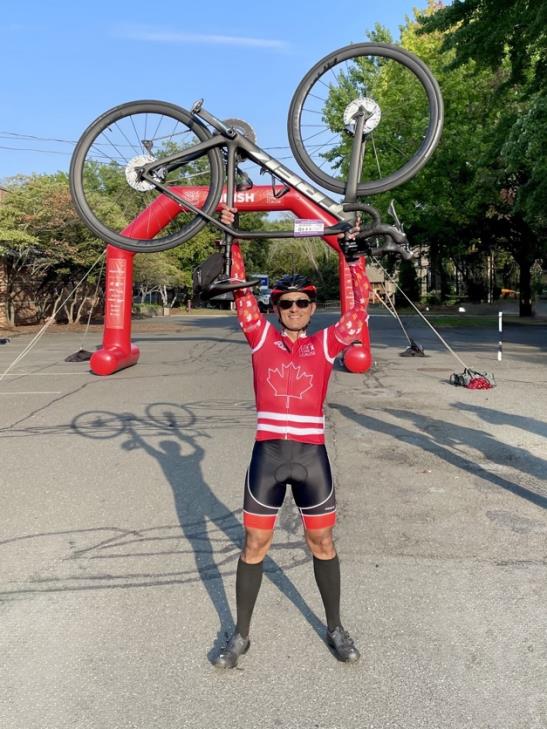
In my forties I signed up for a 450-kilometre, three-day endurance ride from Boston to New York. There was one problem: I did not own a bike. I had never ridden one.
I finished it. Then I did it five more times. Every limit I had quietly accepted started cracking after that — and that is the thing I actually coach. Not a workout. The evidence that the ceiling you assumed was real was never real.
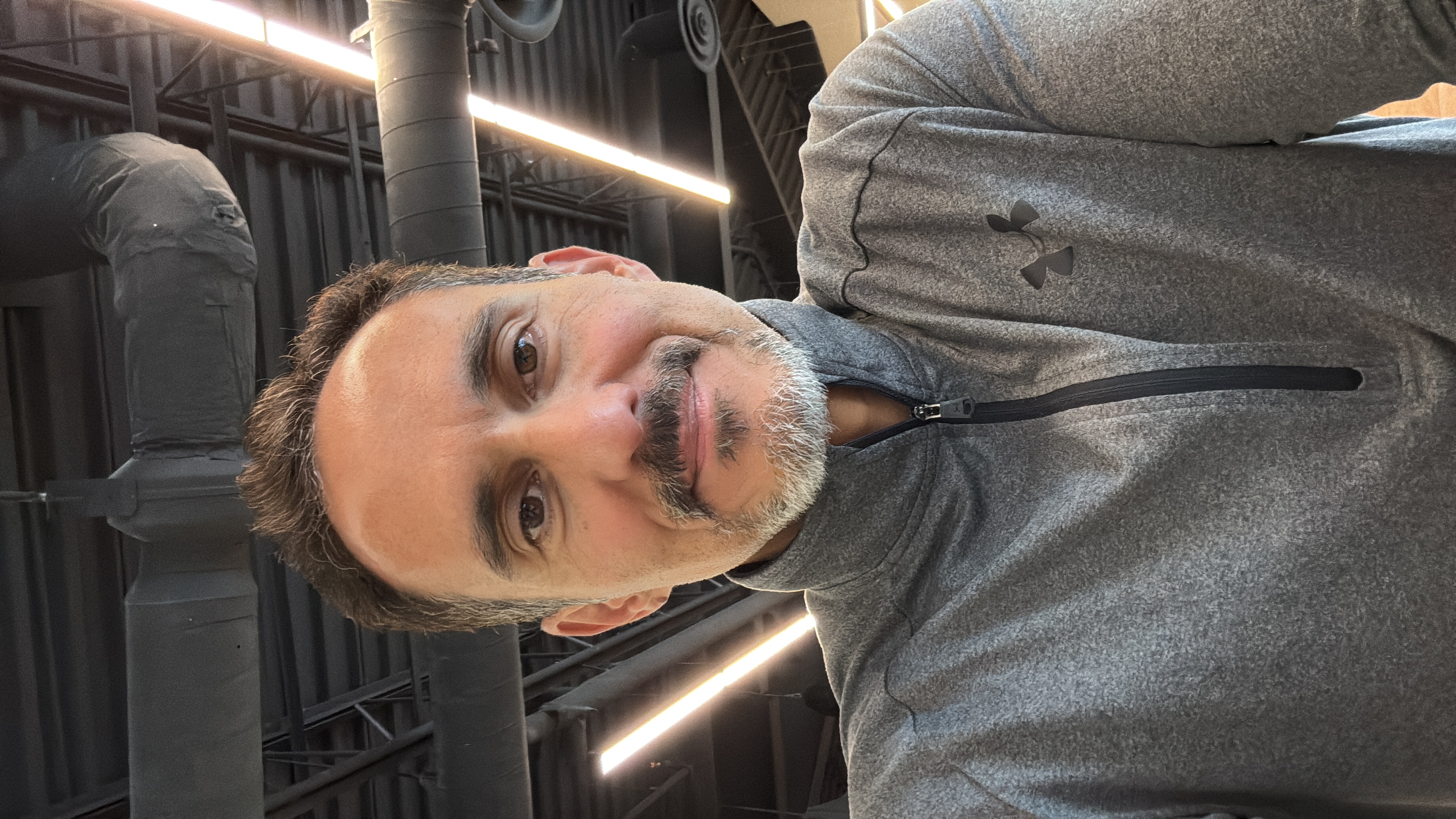
I am an ISSA Certified Personal Trainer with more than thirty years of training behind me — cyclist, runner, weightlifter, husband, father, and a former business leader who spent decades fitting training around a demanding job. I know exactly what a bad week looks like from the inside, because I have had thousands of them.
I am not unique. Every man I coach carries the same latent capacity. He just needs someone to show him the roadmap.
Then you already have something most men never get: a real before-and-after. You measured in your first week, and again on Day 13, and you know exactly what fourteen days of small, consistent inputs moved.
Bring those numbers with me. They become the first page of your Blueprint — a starting point we did not have to guess at, and a set of markers we can already see the trend on.
And you already know the honest limit of the Challenge: it is the same fourteen days for everybody. That is what makes it work, and it is also why it can only take you so far. This is the part that was built for you.
One payment, all in. No separate onboarding fee. No contract. No auto-renewal.
For context: standard onboarding on its own is US$399, and monthly coaching runs from there. This is what six weeks costs when you start here.
Five spots per block, because I read every check-in myself and there is a real limit to how many weeks I can read properly.
What Happens at Week Six
You will have your retest numbers and a plan that has already survived six weeks of your actual life. From there you either continue month-to-month, or you stop and keep running the plan on your own. There is nothing to cancel and nothing that renews without you deciding it should. Either way the six weeks did their job.
My Commitment at Week Six
We retest at week six. If you did the work and the numbers have not moved, I rebuild the plan and coach you through the next block at no charge.
That is not a refund, and I do not offer one. I would rather fix it than hand your money back and leave you exactly where you started.
Coming from a Challenge Pitch?
Take a spot within 48 hours of the pitch and I will add two extra 1:1 calls inside your six weeks. The deadline is in your email as an actual day and time — not a countdown clock. The price does not change. The calls do.
The second best time is right now.
Six weeks from today you will either have a plan built around your life and the numbers to show it works —
or you will be exactly here, six weeks older, still deciding.
Stop guessing. Start building — for the long game.